The AI Revolution in Search: How Google’s AI Overviews Are Reshaping Visibility in 2026
Here’s something most business owners haven’t realisedrealized yet: if you own an iPhone — and statistically, you probably do — your default search experience has already changed.
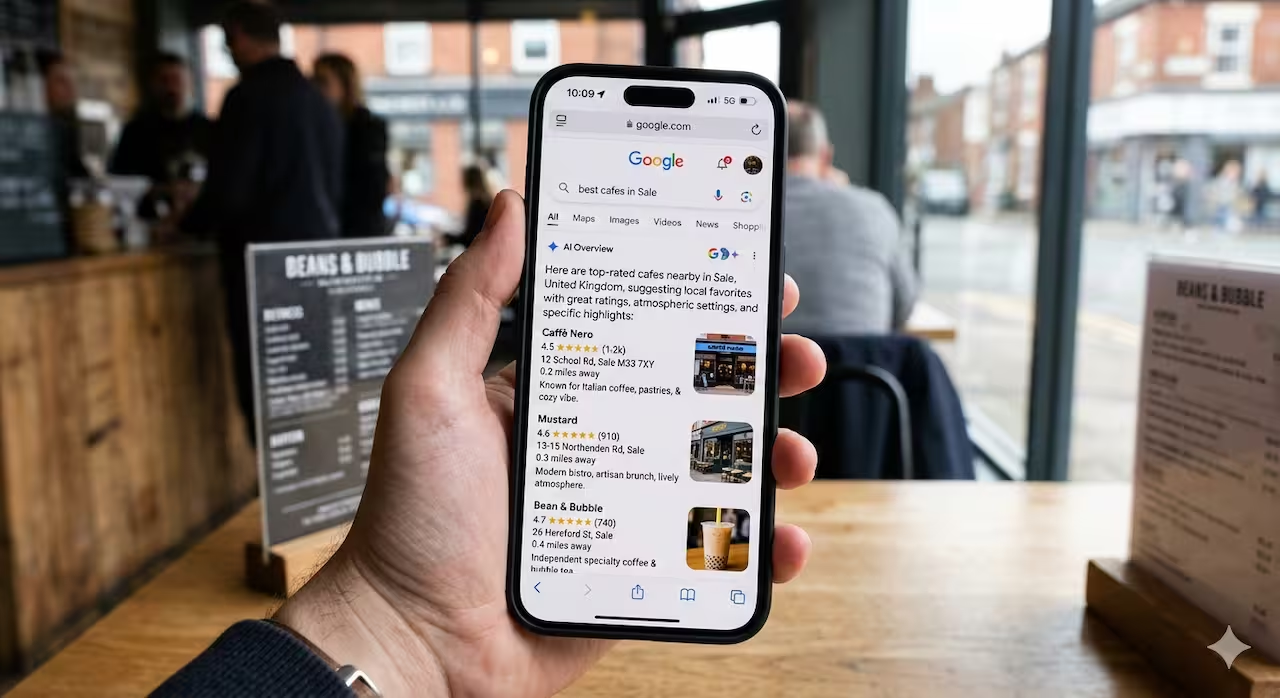
Apple’s Safari browser now defaults to AI-powered search results on mobile devices. When a customer picks up their iPhone and types “emergency plumber near me” or asks Siri for a recommendation, they’re no longer scrolling through a page of ten blue links. They’re getting a single, AI-generated summary at the top of the screen — a synthesisedsynthesized answer that names specific businesses, pulls in pricing, references reviews, and often answers the question completely without the user ever tapping through to a website.
This matters enormously for trades and local service businesses because of the sheer scale involved. In the UK, iPhone holds roughly 50% of the smartphone market. In the US, it’s closer to 57%. That means more than half of your potential customers are now experiencing search through an AI filter by default — not by choice, not because they opted in, but because Apple quietly made it the standard.
The Old Rules No Longer Apply
The old model was simple: rank on the first page, get clicks, get calls. The new model is brutal in its simplicity — either your business appears in that AI-generated answer, or it doesn’t exist for that search. There’s no second page. There’s no “scroll down a bit.” The AI picks its sources, assembles its answer, and the customer acts on it or moves on.
What determines whether your business makes it into that answer? Exactly the factors AI models prioritiseprioritize: fast-loading pages they can crawl efficiently, structured data they can parse, clear and authoritative content they can cite with confidence, and consistent business information across the web that confirms you’re legitimate and active. A slow site with vague copy and no schema markup doesn’t stand a chance — regardless of how good your actual service is.
This is the uncomfortable truth of search in 2026. Your reputation as a tradesperson might be spotless. Your reviews might be glowing. But if your website can’t communicate that information in a format AI systems understand, you’re handing customers to competitors whose sites can.
The Numbers Behind the Shift
By early 2026, AI Overviews appear in nearly 55% of all Google searches globally and around 50% of queries in the United States. Google has rolled it out across 200 countries and 40 languages, reaching an estimated 1.5 to 2 billion users monthly. In Safari, where Google remains the default search engine, these AI summaries are now the first thing people see for informational and even some navigational queries.
The result? Search behaviourbehavior is changing fast. Studies show that 37% of consumers now start their searches with AI tools rather than traditional Google results. Another 80% rely on AI-generated summaries at least 40% of the time. Zero-click searches — where users get what they need without visiting any website — have climbed to 58–60% of all queries.
When an AI Overview appears, organic click-through rates plummet by as much as 61%, dropping from roughly 1.76% to 0.61% in some analyses. Paid clicks fare even worse, with declines up to 68%. Users are simply getting their answers faster and moving on.

This isn’t hype — it’s data-driven reality. Pew Research found users are half as likely to click traditional links when an AI summary is present, and only 1% click on links embedded inside the AI Overview itself. Younger users, especially Gen Z, are accelerating the shift, often turning to ChatGPT, Perplexity, or Gemini first for quick answers.
Why This Matters for Small Service Businesses
For small service businesses — plumbers, electricians, locksmiths, roofers, HVAC technicians — the implications are immediate and stark. These trades have historically thrived on local search: “emergency plumber near me,” “24-hour locksmith Manchester,” or “electrician Boca Raton reviews.” Informational and commercial-intent queries like these used to drive qualified traffic directly to websites. Now, AI Overviews often summarisesummarize the answer and cite just a handful of sources, pushing the actual websites further down the page or rendering them unnecessary.
Data from 2025 shows organic traffic drops of 20–70% for sites heavily dependent on informational content once AI Overviews take hold. Publishers, recipe sites, and local service pages have been hit hardest. Even when a site is cited in an AI Overview, the click often never comes. Impressions might rise, but revenue-driving visits fall.
Small businesses without a strategy tailored to AI search risk becoming invisible — not because they rank poorly, but because the new search results page simply doesn’t need users to leave Google.
Traditional SEO Is No Longer Enough
Traditional SEO — chasing keywords, building backlinks, and hoping for page-one rankings — is no longer enough. AI Overviews reward content that is authoritative, well-structured, and easy for machines to parse and cite. That means clear headings, bullet points, FAQs, schema markup, E-E-A-T (Experience, Expertise, Authoritativeness, Trustworthiness) signals, and original insights that AI can’t easily replicate elsewhere. Generic “we are the best plumber” pages get ignored.
If you’re curious about how your current site stacks up, our study of 100 UK trade websites found that 94% fail Google’s own speed standards — and speed is now one of the primary factors AI systems use when selecting sources.
Site Speed: The New Non-Negotiable
Here’s where things get even more critical: site speed now matters more than ever. Google’s AI systems fetch and summarisesummarize live content in real time. Slow-loading pages are less likely to be crawled deeply, indexed promptly, or selected for AI Overviews.
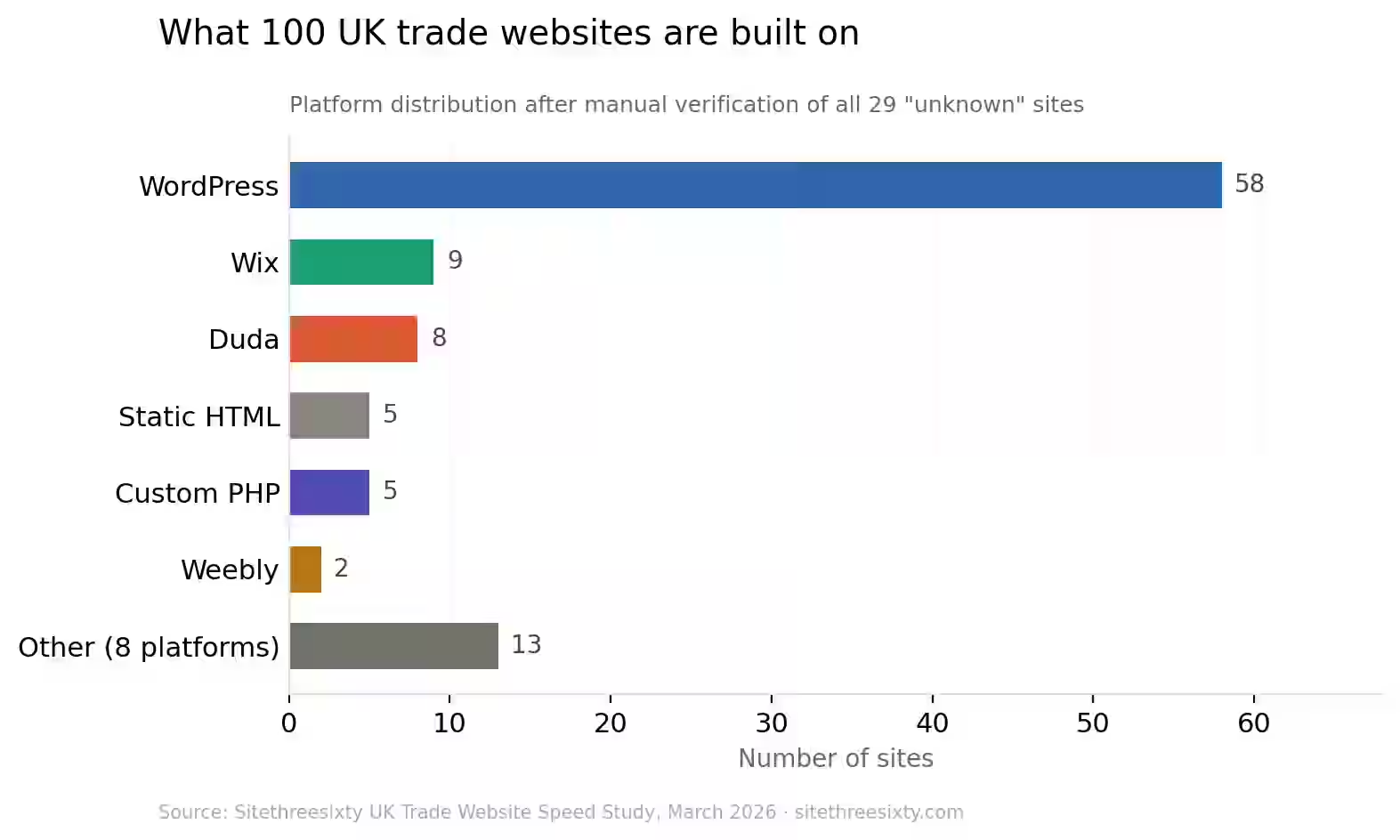
Core Web Vitals — loading performance, interactivity, and visual stability — directly influence whether your site even qualifies as a high-quality source. Studies in 2025 confirm that fast sites enjoy better crawl budgets, higher inclusion rates in generative results, and lower bounce rates when users do arrive. A sluggish site built on bloated DIY platforms or outdated code simply can’t compete in an AI-first world.
We’ve written extensively about how we achieve perfect 100/100/100/100 PageSpeed scores and why it matters. In the age of AI search, those scores aren’t just bragging rights — they’re a competitive advantage that directly affects whether your business gets cited.
Most small businesses can’t afford to hire full-time developers or SEO teams to keep up. They sign up with a web designer once, the site goes live, and then… it slows down, gets hacked, or the developer disappears. Traffic dries up, and the business wonders why the phone stopped ringing.

What Separates an AI-Ready Website from One That Gets Ignored
So what separates a website that gets cited in AI answers from one that gets ignored? It comes down to a handful of fundamentals that most web designers and DIY builders consistently overlook.
Speed isn’t optional anymore — it’s the entry ticket. If your site takes more than two seconds to load, AI systems are less likely to crawl it deeply or select it as a source. That rules out most bloated WordPress themes and drag-and-drop builders straight away.
Content needs to be structured for machines as well as humans. That means proper schema markup telling search engines exactly what your business does, where you operate, what services you offer, and what your customers say about you. It means FAQ sections that directly answer the questions your customers are actually typing into their phones. It means clear headings, logical page hierarchy, and content that leads with the answer rather than burying it under three paragraphs of waffle.
It has to be maintained. AI systems favourfavor fresh, regularly updated content from sites that demonstrate ongoing activity and authority. A site that was built two years ago and hasn’t been touched since sends the opposite signal — to both Google and the AI models that feed from it. This is one of the key reasons fully managed websites outperform set-and-forget builds.
E-E-A-T signals matter more than ever. Experience, Expertise, Authoritativeness, and Trustworthiness aren’t just Google buzzwords — they’re the criteria AI models use to decide which sources deserve to be cited. Reviews, credentials, consistent business information across platforms, original insights that can’t be found elsewhere — these are what push a business from invisible to cited.
The challenge for most small service businesses is obvious: who has time to manage all of that while running jobs, answering calls, and keeping customers happy?
Built for the AI Era
This is exactly why Sitethreesixty exists. Unlike typical web design agencies that hand off a site and walk away, or DIY builders like Wix that leave you to maintain everything yourself, Sitethreesixty delivers a true “done-for-you” experience.
Custom coding, hosting, security, ongoing updates, and performance optimisationoptimization — all handled for a fixed monthly fee. No surprise bills. No vanishing developers. Every site is rebuilt with clean, efficient code that keeps the original design if you prefer, but dramatically improves speed and SEO from day one. All sites are hosted on Cloudflare’s global network, with 95% of managed sites achieving a perfect 100/100 score on Google PageSpeed Insights.
AI SEO is baked in from the beginning. Structured data, conversational content frameworks, E-E-A-T signals, and fast-loading architecture are standard. The service also includes a client portal called 360Dash for real-time performance tracking and easy change requests, plus optional add-ons like online booking, payments, and AI-assisted content publishing tools.
Transatlantic expertise sets the service apart too: operating between the UK (Manchester) and the US (Boca Raton), offering native-level localisationlocalization, culturally attuned messaging, and local billing in both GBP and USD.
What This Costs
Two plans — paid monthly, 30-day rolling contracts, no upfront fees:
360 Lite: £50$65 per month — 3-page website, SSL, core SEO, and 2 email addresses.
360 Pro: £100$130 per month — Full multi-page site, advanced AI-optimisedoptimized SEO, integrated booking and payment systems, and ongoing management.
Whether you have an existing slow or outdated site that needs a custom rebuild or you’re starting from scratch, Sitethreesixty solves the exact problems the AI search shift has created: slow performance, poor AI visibility, and the headache of ongoing maintenance.
Get a Free Site Review → See exactly how your current site performs against AI Overviews and PageSpeed benchmarks — no charge, no obligation.
View Pricing Plans → Monthly pricing. No contracts. No upfront costs. Charter rates available.
Frequently Asked Questions
What are Google AI Overviews and how do they affect my business?
AI Overviews are AI-generated summaries that appear at the top of Google search results, answering queries directly without the user needing to click through to any website. They now appear in roughly 55% of all searches. For local service businesses, this means that if your website isn’t selected as a source for these summaries, potential customers may never see your business at all — even if you previously ranked well in traditional search results.
My website already ranks on Google — do I still need to worry about AI search?
Yes. Traditional rankings and AI Overview citations are assessed differently. A page that ranks position 3 for a keyword might not be cited in the AI Overview for that same query. AI systems prioritiseprioritize fast-loading pages with structured data, clear authoritative content, and strong E-E-A-T signals. With zero-click searches now at 58–60% of all queries, even a page-one ranking delivers far fewer clicks than it did a year ago.
Can a slow website still appear in AI Overviews?
It’s unlikely. Google’s AI systems fetch and process content in real time. Slow pages are crawled less frequently, indexed less thoroughly, and are less likely to be selected as authoritative sources. Core Web Vitals — particularly Largest Contentful Paint (LCP) — directly influence source selection. If your site takes more than 2–3 seconds to load on mobile, you’re at a significant disadvantage compared to faster competitors.
What’s the difference between traditional SEO and AI-ready SEO?
Traditional SEO focuses on keywords, backlinks, and page-one rankings. AI-ready SEO goes further: it requires structured data (schema markup) that machines can parse, conversational content that directly answers questions, FAQ sections, strong E-E-A-T signals, and a technically fast site that AI crawlers can access efficiently. Think of it as building your site for two audiences simultaneously — humans who read it and AI systems that decide whether to cite it.